1. Karush–Kuhn–Tucker (KKT) conditions
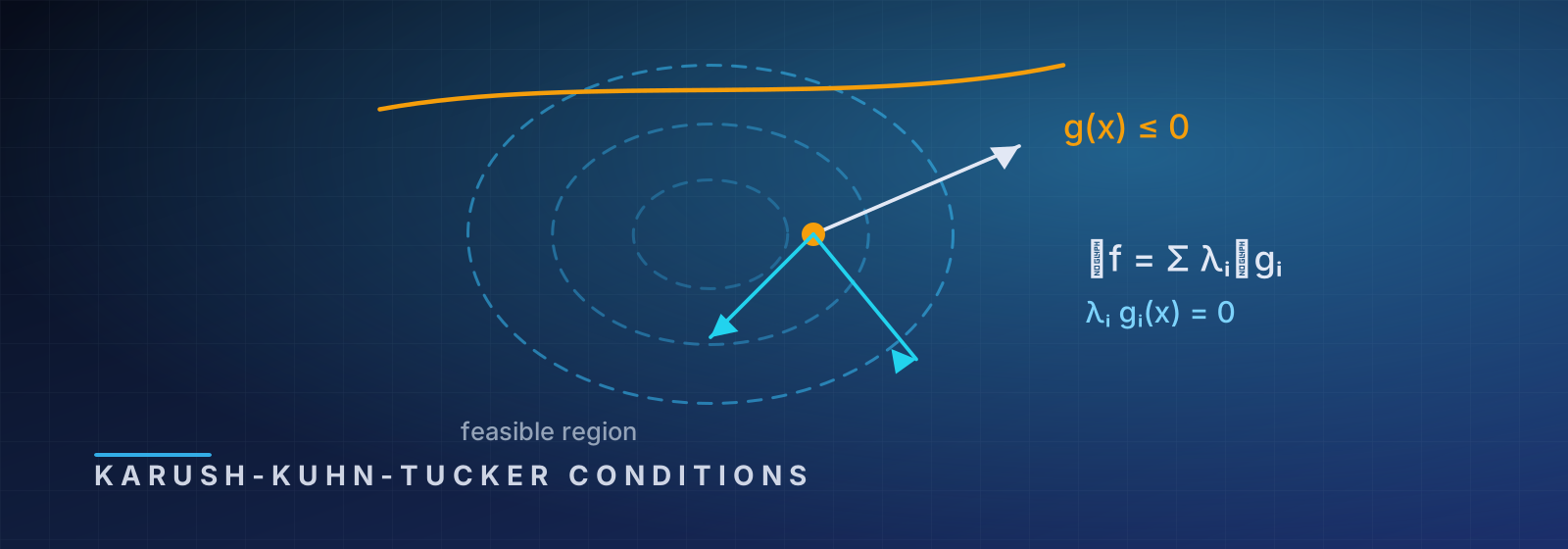
The KKT conditions turn a constrained optimization problem into stationarity, feasibility and complementary-slackness equations. Use them to test whether a candidate point can be optimal, and to derive closed-form solutions for constrained learning problems.
- Reading time
- 2 min
- Length
- 276 words
- Updated
- Sep 15, 2026
- Total views
- --
1. Concept of KKT Condition
(1) problems for solve
The standard-form of optimization problem is given as [1] :
Where
Then the Karush-Kuhn-Tucker Condition[1:1], Firstly, we can construct the following Lagrangian function :
Re-write (1.1.2) gives :
(2) The KKT condition
The Karush-Kuhn-Tucker Condition state the following sufficient and necessary conditions :
- Sufficiency : If
is the saddle point of in then is an optimal vector for the optimization problem (1.1.1) - Necessity : Suppose
and , are convex in , and there exists :
that is, slater's condition[2] holds, Then with an optimal vector
satisfying
(3) Necessary condition
For the part :
then :
For minimizing
The equation (1.3.2~3), or often (1.3.3) are called KKT condition
Complementary Conditions We note For (1.3.3), the KKT conditions for inequality boundaries are complementary conditions :
For an illustration, see [^3]
Feasibility :
- This is a necessary condition for finding the optimal solution, but it only holds true if the problem satisfies certain regularity (such as the Slater condition).
- For non-convex problems, points satisfying the KKT conditions may be local optima, saddle points, or even extreme points.